
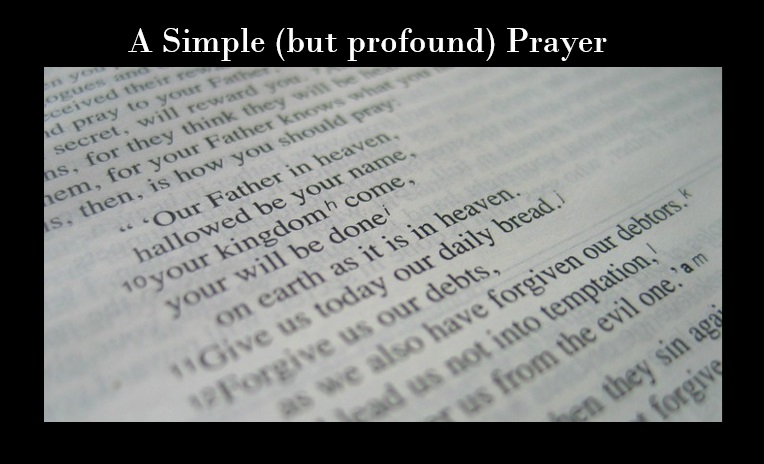
A long time ago, while the disciples were sitting with Jesus, they asked him how to pray. Jesus answered them. He first told them that God already knew what was in their hearts. He then shared with them some simple words to be used for prayer. These are words that have profound meaning. We know these words as The Lord’s Prayer.
Sometimes when we have things memorized, when the words we recite become part of our rote memory, we say them without really thinking. The words then become nothing more than part of an exercise we follow. When that happens, the words and the recitation actually lose value, relevance, and meaning. Words only mean things when we consider what they are saying to us.
For example, when was the last time any of us really thought about the words in the Pledge of Allegiance? We say the words, but we don’t often think about them or consider their meaning. I think the same is often true about The Lord’s Prayer.
A good number of years ago, I began the habit of saying The Lord’s Prayer with each mile I run. For a guy who runs over a thousand miles each year, and sometimes close to two thousand, that’s a lot of time spent with the same words. As I have shared in sermons in churches and at the religious services at the start of the New York City Marathon, and other places, I think about those words a lot. I have come to embrace the words of The Lord’s Prayer. I look forward to reciting and thinking about them with each mile I run. (Having a treadmill and a Garmin watch that tracks my miles helps tremendously in this). I believe the words of this prayer help me run a little better and a little stronger. The prayer takes my focus off of myself and allows me, if only for a few moments, to think about things much bigger than the struggles I might be going through. I have often said that while it seems like I’m running alone, I’m actually not. When I pray as I run, God is there with me. I know this because I can feel His presence.
And yet, even with all of this, sometimes, probably far too often, I get in the habit of saying the words of The Lord’s Prayer without truly considering them. I wish I had better focus in that regard. Still, often enough, I do think about them and work to embrace and cherish all of the words in my heart, mind, and soul.
I’d like to share, in general, what the words in The Lord’s Prayer mean to me. The prayer is simple, but it is profound in meaning. I believe when one recites and truly considers The Lord’s Prayer, it will bring that person closer to God. And that, of course, is always a good thing.
Our Father Who Art In Heaven, Hallowed Be Thy Name
These big words start off the prayer with power and majesty – and a true seriousness of purpose. They set the stage perfectly, like a great opening chord in a song. Think of the opening of Beethoven’s Fifth Symphony. Boom! It starts. You’re immediately there and engrossed. It’s real. Very real. It’s real and authoritative. You cannot escape it. You’re instantly part of something important and meaningful and powerful.
With The Lord’s Prayer, you begin by calling God, in Heaven, to you. “You are the Father of all,” you’re saying, “You reign, forever, in Heaven (the place I’d like to be, one day, but hopefully not too soon) and your name is the most precious and cherished one of all.”
With this start of the prayer, you are acknowledging that God is the beginning and the end, and everything in between. There is nothing more hallowed, special, important, praised, or held lofty than His name.
And now, with this prayer, with this call to Him, you are communicating directly with God while showing your reverence, as you ask him to listen to your humble words…
Thy Kingdom Come
In this you are simply acknowledging that the kingdom of the Lord is with us. It is here and you don’t just recognize it, you are stating that you are part of this kingdom. You’re saying that God’s kingdom is here, right now, and that it is eternal. His kingdom has come. Period.
You’re are stating that you are part of this wonderful kingdom and that you will do your duty to glorify it. But prayer isn’t a one way street – it goes both ways, from us to God and from Him back to us. We have a big part in this. His kingdom is here. It is for us to be active in it.
(Just think about this, since the kingdom is here, in God’s love and spirit, and glory, why wouldn’t we take part in it? What could, in any way, be better?)
Thy Will Be Done On Earth As It Is In Heaven
That passage is enough to make us pause.
With these words we are recognizing that as flawed as we all are as people who sin way more often than we admit or willingly acknowledge, that we will do our part to bring the glory of God’s Heaven into our daily lives here on Earth.
We are asking for God to do the things he does in Heaven on Earth, but for that to happen, realistically, we must each do our parts to live lives as holy as we can. If Heaven is made of angels and goodness, we have to be those sources of goodness here. If we don’t do our part, if we’re not willing, how can He do His part? We’re saying, “We will help to make this world as much like Heaven as we can.” That’s what we’re asking for – to make Earth heaven-like.
I’ll break here for a quick aside. I said The Lord’s Prayer a few weeks ago to a mixed audience that included members of the Jewish faith as well as Christians. A person asked me if I did the right thing, after all this is a Christian prayer, one taught by Jesus. As I thought about all of these words, I responded that there is nothing in them to make them unacceptable to any believer in Judeo-Christian ideals or values. Jesus, a Jew, shared them with his disciples, also Jews, who clearly understood all of this within the context of their religion. The only truly Christian aspect of The Lord’s Prayer (as I see it) is the fact that it was explained by Jesus Himself. But, if these words were shared by Moses or Elijah, or David, they wouldn’t necessarily be any different. In fact, I could see this prayer fitting comfortably in Psalms or in numerous other places in the Old Testament. Jews and Christians alike worship the same God.
Give Us This Day Our Daily Bread
When I really consider these words, I always think the word “please” belongs in there. Far be it from me to improve upon this prayer, but these words are asking God to sustain us. When we ask for things, a simple “please” is usually (if not always) appropriate. In this part of the prayer, we recognize that without our daily bread, our daily sustenance and nourishment, we will soon be no longer. God provides our daily bread to us (and for most of us, it is provided in great abundance). We are here because of Him. We are sustained because of Him. We thrive through Him.
Sometimes when I recite the prayer, if I don’t say “please give us…” I will add in “…for which I thank you” after these words. I think it is right and proper for us not only to say “please,” but “thank you” as we ask God to provide for our daily needs.
This short line also expresses (and reminds me) why it is important to say grace before our meals. God is providing for us. Our responsibility in love is to acknowledge and to be thankful for being provided. It never hurts to be thankful and it is always good to give thanks. We should all probably give thanks for so much, and to so many, much more often than we do. (Remember, we just said in prayer, to God, that we’re trying to make our lives on Earth like the ones in His glory in Heaven).
And Forgive Us Our Trespasses
In order to grow and thrive and self-actualize, we need God to forgive our many sins. This is also a good place to acknowledge where we fall short of God’s ideals. It’s difficult (if not impossible) to get forgiveness if we don’t ever state what we’re asking forgiveness for.
We are blessed that God does forgive us, that’s why we’re asking for this. (Again, a “please” here wouldn’t hurt.)
But there is a catch…
As We Forgive Those Who Trespass Against Us
Wait. What?
Yes.
Read those words again. You know what they say. And they say a lot.
The critical word in this part of The Lord’s Prayer is “As.” These eight words are a critical part of the forgiveness we ask. The two cannot be separated.
We are asking for our sins to be forgiven, but only as we forgive the others who have sinned against us. We’re not asking God to forgive them, we are saying that we will forgive them – that we won’t hold all those grievances in our hearts. We are saying, “As I forgive others, please forgive me.” We don’t get forgiveness first. We have to be part of the giving here. It’s not “Forgive us, and I’ll consider forgiving others.” No way, not at all. It’s “As I forgive, please forgive me.” Our forgiving has to come first. If we want Earth to be Heaven-like, we must be as gracious as angels. This is a great place to start.
What we’re saying here is a difficult task. We’re asking for a lot. We want to be forgiven for our mistakes, big and small, but we’re also promising to be as generous and loving with those who have wronged us. God is showing here, or Jesus did (when he taught the prayer), that we are a critical and essential part of the forgiving process. If we don’t forgive, we should not be asking for forgiveness from the one whose name is hallowed and who is working to bring Heaven to Earth. Heaven can’t come if we’re not willing to put forgiveness to others above our own wants, needs, and jealousies.
And Lead Us Not Into Temptation
The world is full of temptation, in many forms, in many ways that confront us daily (and seemingly continually). As strong people, we need to resist whatever those temptations are. Here we’re again asking for God to give us that strength.
But Deliver Us From Evil
It was the source of evil that brought about mankind’s first sin. That sin has been ever present ever since. There is only one sure fire way to combat evil, and that’s with goodness, pure goodness, unmistakable goodness. We need God’s goodness as the one true protection from evil.
In Lord’s Prayer as written in the Bible, this passage reads as “deliver us from the evil one.” Yeah. Powerful stuff. Most people never consider this as they rotely recite the words of The Lord’s Prayer.
With these words, we are acknowledging that in all we do, in order to move forward, we need God’s strength and love and kindness and support. In short, we need God. We need God more often, probably by gazillions, than we ever admit.
For Thine Is The Kingdom And The Power And The Glory Forever
Some faiths don’t say these words as a direct part of the prayer. These words aren’t in the Biblical passage that Jesus teaches his disciples. Nonetheless, I think they’re essential. They’re essential, at least, to me.
God is all of those things, the kingdon, the power, and the glory forever, and more. That’s why we’re praying to him. That’s why we are asking for His grace, His love, His abundance, His strength, and His forgiveness. That is what we are praying for here (and probably in some ways, always). We’re asking because we can only get any of these things, in reality, from Him because God is the kingdom, the power, and the glory forever. And, in the end, we pray this prayer because we wish to be part of all of that. If God wasn’t those things (trust me, He is), we wouldn’t be praying to Him. It is fitting a proper that as we close the prayer, we acknowledge who God is and our reverence for Him.
Amen.
Yes. Amen.
 Dr. Sem's Blog
He is God, and we are not. It is impossible to move forward without this acknowledgement, which is why I think the opening of the Lord’s prayer reflects this. It’s only then that we can begin to recognize the battle found within each of us — the tension between our flesh and God’s will, trusting that He knows best (although I’ve failed at this part more times than I’d like to admit!)
LikeLiked by 1 person