As most know, I am diligently working on my three-volume series of books titled West Point at Gettysburg.
This series tells about the lives of every single West Point graduate, both Union and Confederate, who fought at the Battle of Gettysburg in July 1863.
I have toured the Gettysburg battlefield many times and have conducted research with the National Park Service staff using the vast resources at the battlefield park. When I visit the battlefield, I feel at home because I am visiting a place that has become very very familiar to me.
But, while I have spent countless hours on Cemetery Hill, Little Round Top, the Peach Orchard and Wheatfield, Devil’s Den, and the like, I had never, until yesterday, spent any time on the lesser-known battlefield in Gettysburg – East Cavalry Field.
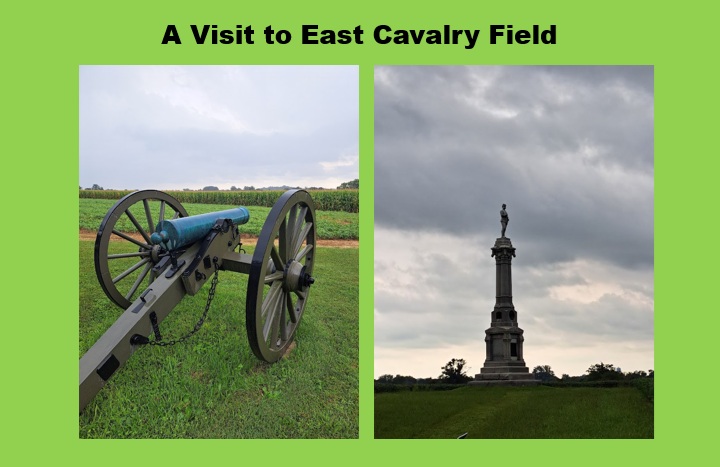
Yesterday, my son Ryan traveled to Gettysburg to explore East Cavalry Field. We parked at the entrance and walked the main road of the park reading the markers and monuments, and doing our best to imagine the struggles there that occurred on the afternoon of July 3, 1863 resulting in the final Union victory in the overall battle.
But, as I walked the ground, learned, and enjoyed the scenery, a thought popped into my mind…
On the main battlefield, there are no fewer than eight equestrian statues to the men who led on that battlefield.
Generals Winfield Scott Hancock, Oliver O. Howard, Robert E. Lee, James Longstreet, George Gordon Meade, John Reynolds, John Sedgwick, and Henry Slocum all are memorialized on horseback on the battlefield.
But, at the location where the calvary is highlighted, where there was an epic cavalry battle, there isn’t an officer on a horse monument to be found.
Generals JEB Stuart and George Armstrong Custer both very well known for their service on horseback, of course, along with numerous other generals, fought bravely at East Cavalry Field yet there are no horseback monuments to those men – or any others.
I found this to be a fun little fact.
I love finding little historical oddities like this – a field dedicated to honor a struggle among horseback riding soldiers – and not an equestrian monument to be found.
(Of note, East Cavalry Field is well worth a visit. One gains a better understanding of the struggle there by visiting this area. The lack of a soldier mounted on a horse does not, in any way, distract from this important part of the Gettysburg battlefield. I look forward to returning there soon.)

